
According to user crypto4design, acting in the capacity of a web developer, he received payment for completed work in bitcoins. To avoid high transfer fees to centralized exchanges and to purchase Monero (XMR) for long-term investment, he decided to use the FixedFloat service. The client sent the payment directly to the address provided by the exchange. After completing the work, the developer discovered that his funds, amounting to over 8,000 euros, had been frozen.
According to crypto4design, the exchange suspected the funds were linked to criminal activity (the Darknet). The user provided extensive evidence of his honesty: screenshots of Telegram conversations, exported chat archives, and a video recording of the communication with the client. However, as the user noted, the service's representatives rejected the exported chats, stating that they could be forged, and continued to request new data, which indicates an attempt to drag out the process.
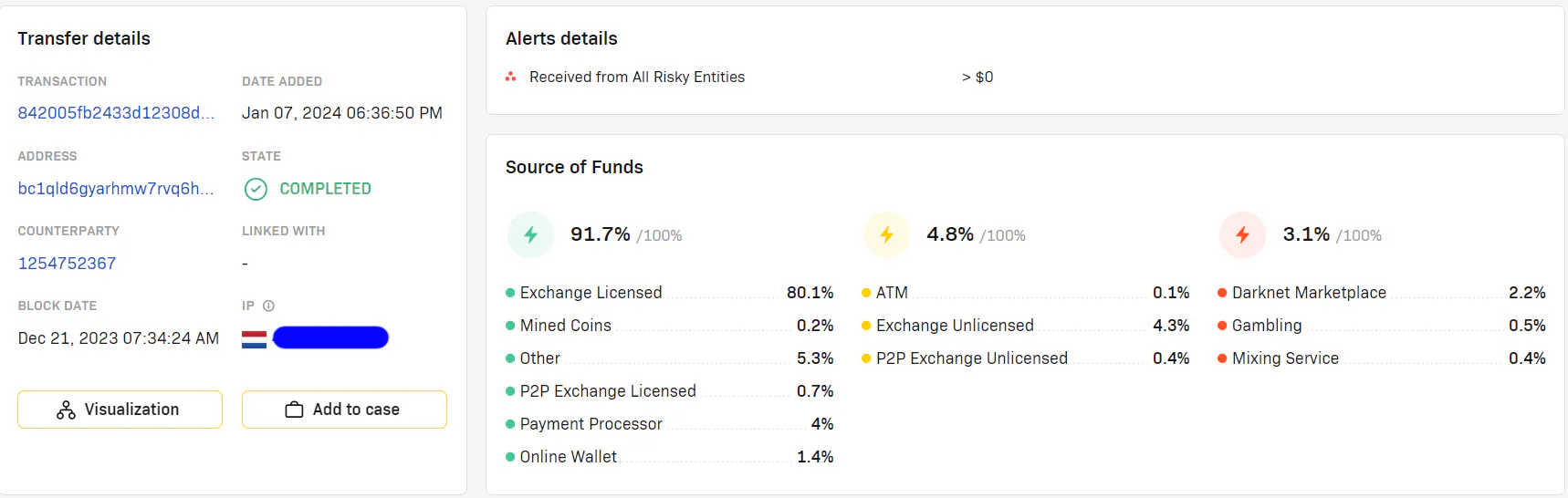
The official service representative, the account fixedfloat, joined the discussion on the forum. According to user fixedfloat, the service received information from "partners" that the funds were obtained through criminal means. The exchange refers to clause 7.7 of its Terms of Service (ToS), which states that information about the origin of the funds must be provided directly by their sender.
Later, according to fixedfloat, the entire amount (and not just 2.2%, as initially indicated in the AML analysis screenshot provided by crypto4design) was deemed linked to criminal activity. The representative also stated that the company is based in the Seychelles, operates worldwide, and does not conduct KYC (identity verification procedures), but in exceptional cases reserves the right to request verification, which it communicated to the sender of the funds.
Forum members harshly criticized the exchange's actions, revealing a number of contradictions in its policy and blockchain transactions:
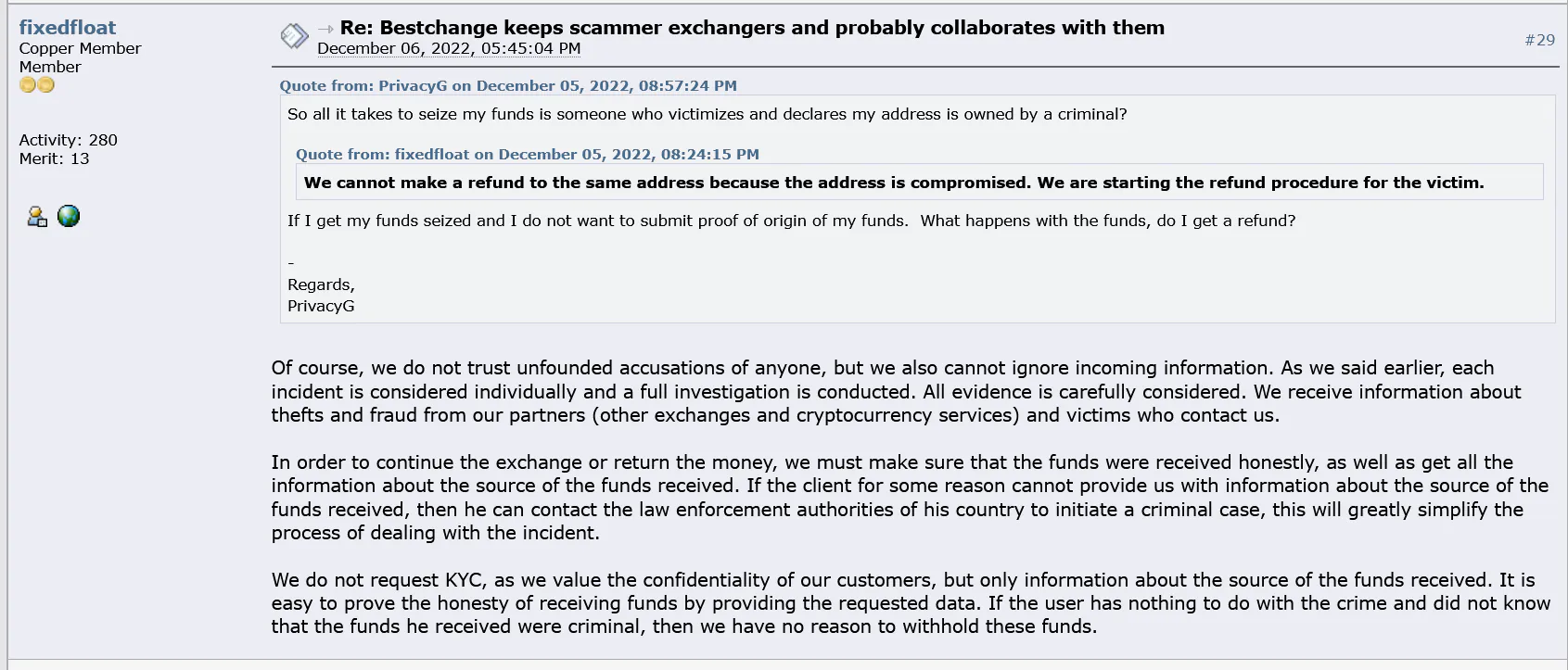
Violation of their own privacy policy: User holydarkness quoted FixedFloat from December 2022, where they stated that they do not request KYC because they value client anonymity, and only request information about the source of funds. However, in practice, the service began demanding personal correspondence and the developer's client data, which directly violates their own declaration.
- Legal groundlessness: According to user alterra57, who has experience in the field of blockchain investigations, only banks and electronic money institutions have the right to request a Source of Funds (SoF), not a crypto exchange. He also noted that the Seychelles does not have a regulatory framework obligating crypto services to freeze funds. In his opinion, FixedFloat's actions qualify as illegal withholding of money and selective scamming.
- ToS (Terms of Service) analysis: User JollyGood drew attention to Section 19 of FixedFloat's Terms of Service. It states that all disputes are resolved exclusively through negotiations, which effectively deprives the client of any legal protection and the right to go to court, since the company's jurisdiction is hidden, and it is not registered as a legal entity (LTD/LLC) in transparent registries.
- Exposing the lie about "frozen" funds: The most important evidence was presented by user LoyceV. He analyzed the blockchain transactions (TxIDs: 842005fb2433d12308d94b0c492bd950ad0aa53ce33aa9a6ff3aa53934ec80f1 and cfcfcdfd29ccd5bb0aaf852076ab9fdd22895d9474c88f84add7f61c53866b73). According to researcher LoyceV, FixedFloat lied about the funds "remaining frozen on their addresses." The transactions show that the funds were consolidated (mixed) with other funds and transferred to the exchange's main addresses https://mempool.space/address/bc1qns9f7yfx3ry9lj6yz7c9er0vwa0ye2eklpzqfw. This means that the "dirty" bitcoins were put into circulation and paid out to other unsuspecting users, which refutes FixedFloat's claims of refusing to be complicit in money laundering.
Retrospective rule changes: User crypto4design noticed that after the public scandal erupted, FixedFloat hastily updated their website interface, adding a mandatory checkbox for agreeing to the terms, which was not there when he made the exchange. This is confirmed by the Web Archive from January 1, 2024 https://web.archive.org/web/20240101102027/https://fixedfloat.com/, proving the exchange's attempt to retroactively cover legal loopholes in its favor.

The service's actions were completely condemned by authoritative members of the BitcoinTalk community, and its reputation in the specialized environment is considered destroyed.
url
| domain | explore | registered | registrar | abuse email | score | average | |
|---|---|---|---|---|---|---|---|
| fixedfloat.com | July 4, 2018 | GoDaddy.com, LLC | 30/100 | 30.5 | |||
| fixedfloat.io | Jan. 14, 2021 | NameSilo, LLC | 30/100 | 30.5 | |||
| ff.io | May 12, 2010 | NameCheap, Inc. | [email protected] | 30/100 | 30.5 | ||
| Blacklist: NoCoin Hexxium QuidsUp URLhaus FadeMind MetaMask Phishunt Badd-Boyz BlackBook CoinMiner OpenPhish ThreatFox TweetFeed PhishRadar Scam Block Abuse Block Phishing DB ScamSniffer PhishDestroy Malware Block Phishing Army Toxic Domains Filters Heroes GlobalAntiScam Phishing Block Pi-hole Trojan Scam Blocklist Fraud Blocklist Pi-hole Malware Crypto Blocklist Pi-hole Phishing Ransomware Block CyberHost Malware Pi-hole Malicious Pi-hole C2 Servers Thread Intelligence PhishDestroy Community | |||||||
crypto address
source
https://bitcointalk.org/index.php?topic=5482815.0
Trust Rating Lost ~ 9276 $
related to this report
related to the category