
Eezzee.online is a niche online exchanger focused mainly on swaps between USDT (TRC-20/BEP-20/ERC-20), BTC, ETH, and ruble accounts at Russian banks (Sberbank, T-Bank/Tinkoff, Raiffeisen, SBP). Judging by the calculator on the homepage, the minimum entry amount is 100 USDT, the ruble reserve is claimed to be around 60 million ₽, and the USDT→RUB rate at the time of checking was about 89.7 ₽ per coin — which looks like a mid-market benchmark with a margin baked in.
The service claims to run something called "EEZZEE Momentum" — an express-swap option for big clients, with details available on request from an operator in private. There's no info anywhere on the site about the legal entity, license, country of registration, or management — the service just positions itself as a "trademark".
Regulatory status: a gray zone with no ID markers
There's not a single word in the service's documents about who exactly is behind eezzee.online or what law it operates under. The Terms of Service define the Service simply as "a platform enabling individuals and legal entities to conduct transactions with electronic currency" — no mention of the operator, its registration, or any license.
A telling detail: in the "Basic Definitions" section, the payment systems listed are "Yandex.Money, BTC, Perfect Money, QIWI, Payeer and others" — but QIWI and Yandex.Money, in their current form, basically don't exist anymore (QIWI Bank lost its license in February 2024, and Yandex.Money moved over to yMoney and a foreign structure). Looks like this is boilerplate copy-pasted from another exchanger, or written "for future growth" a few years back — which isn't a crime in itself, but hints at a box-ticking approach to documentation.
KYC/AML: three thresholds, a passport video, and a 14-day confiscation
Here's where it gets really interesting. The service has two different AML documents — a short "Policy" and a longer "KYC/AML Policy" — and they contradict each other on Risk Score thresholds:
| Document | Clause | Blocking threshold |
|---|---|---|
| Policy | Clause 2.3 | Risk Score > 30% or a risk flag ≥ 1% |
| KYC/AML Policy | Clause 6.8 | Risk Score > 60% |
| KYC/AML Policy | Clause 7.1 | Risk Score > 61% |



— Clause 2.3 of the Policy vs. clauses 6.8 and 7.1 of the KYC/AML Policy: the thresholds don't match. In one document, blocking kicks in at 30%; in the other, at 60–61%. And even within the KYC/AML Policy itself, the threshold in clause 6.8 is 60%, while in neighboring clause 7.1 it's already 61%. If a client reads only the short policy, they might expect a block at 30%, when in reality it happens after 60% — or the other way around. This kind of mismatch looks like sloppy editing, but in practice it gives the service room to interpret the threshold "however convenient for the specific case".

— Clause 2.4 of the Policy: a KYC procedure with a selfie video holding your passport. You're required to record "a quality selfie video where you hold your passport next to your face" then, without stopping the recording, show your wallet/account with the transaction hash. Screenshots and screen recordings are not accepted. On one hand, this makes sense as protection against mules and fraud. On the other hand — collecting passport videos at an anonymous service with no legal entity is the perfect identity-theft kit. If a database of these videos ever gets sold or leaks, the consequences for the client will be far worse than a run-of-the-mill scan leak.

— Clause 3.2 of the Policy: a 14-day confiscation. "If the Customer fails to provide the requested data within 14 calendar days after the block, the funds pass into the full ownership of the Contractor". This is probably the harshest clause in the entire documentation. The industry standard when a client refuses KYC is refunding the money minus a fee, or freezing it pending clarification — not the exchanger taking ownership of the funds. And this clause can kick in both in disputed situations and in cases where the client simply didn't make it in time (illness, vacation, lost access) — the wording "pass into full ownership" leaves the client zero room to maneuver.
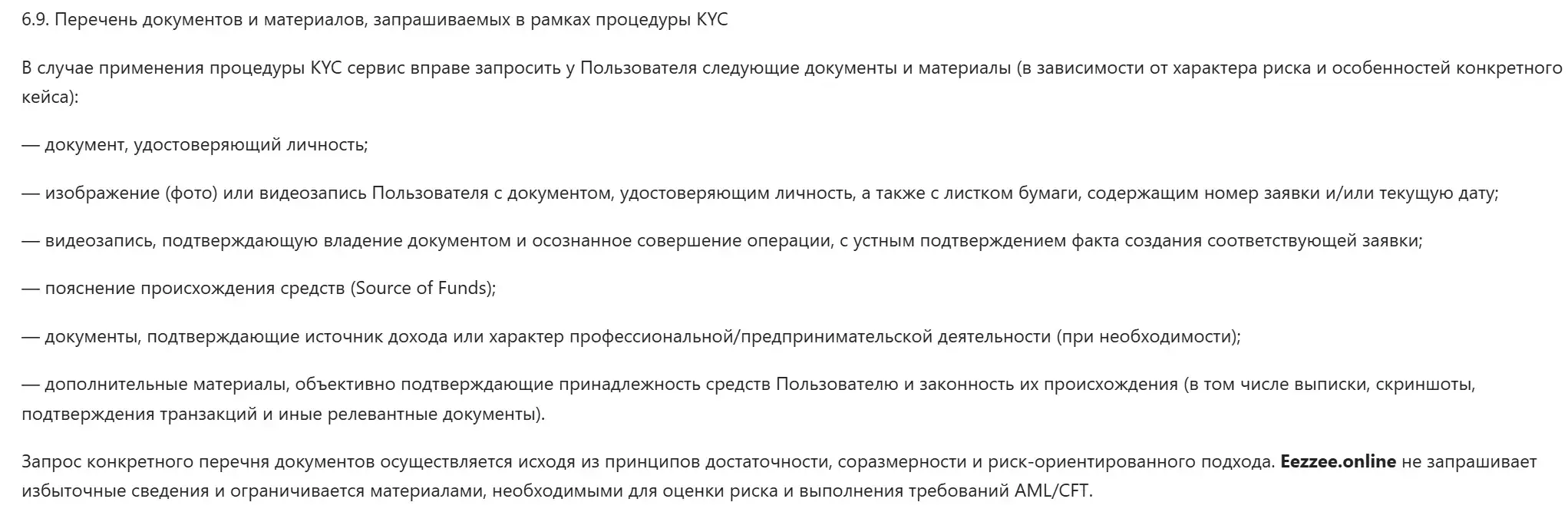
— Clause 6.9 of the KYC/AML Policy: an expanded list of documents. On top of the passport video, the service may request "documents confirming the source of income or the nature of professional/entrepreneurial activity". For an exchanger that, formally speaking, isn't a bank and has no known regulator, asking for income statements looks, to put it mildly, ambitious. It smells like "KYC on demand" with the scope decided by the service itself.

— Clause 8.2 of the KYC/AML Policy: a fee of up to 4% on refunds. "In case of refunding funds suspended as part of an AML check, eezzee.online may withhold a fee of up to 4% of the transaction amount, but no more than 100 USDT". Formally it's "may, but is not required to" (clause 8.3 clarifies that "good-faith users" get refunds without a fee), but the wording "may withhold" with no clear criteria for what counts as "good faith" leaves wiggle room for selective application.
Personal data: stored with no deadlines, shared with no borders

— Clause 10.1 of the KYC/AML Policy: "Data processing and storage... is carried out in a secure internal perimeter with restricted access". Sounds nice, but it doesn't say: where the data is physically stored, in what jurisdiction, for how many years, who has access, or whether there's a deletion procedure at the client's request. The standard GDPR-level questions (even if the service doesn't fall under GDPR) are simply dodged here.

— Clause 3.4 of the Policy: handing over data upon government requests. "Information about the Customer and their transactions is provided exclusively upon official requests from authorized government bodies within the framework of legislation". Which legislation, though? No jurisdiction is named — which means, in theory, it could be any agency from any country whose "officialness" the service chooses to recognize.
Exchange rules: piecemeal payouts and pushing risks onto the client
— Exchange Rules, the "User Notification..." section, the point about piecemeal payouts: "Payouts in rubles to bank cards may be made in installments — up to 5 transfers. Payouts are made via counter-bids, as well as through third-party verified payment merchants and counterparties". Basically, the money landing on the client's card may come from several different individuals and sole proprietors, not from the service itself. This is the classic scheme for handling the fiat side in Russia (to dodge limits and reduce the risk of account freezes), but there's a flip side: the client's bank sees incoming transfers from strangers with random comments — and it's the client's card, not the service's account, that takes the first hit if the bank gets AML-suspicious. The service knows this — you can tell from the next clause.

— Clause 3.1 of the Exchange Rules: "The Service strongly recommends alternating banks and not using the same bank for exchanges more than once a month". In effect — an open admission that regular transactions through this exchanger can attract your bank's compliance attention. The advice is honest (plenty of exchangers give it), but it's also pretty telling.

— Exchange Rules, the point about confirming incoming transactions: "The User agrees to confirm each incoming transaction. If confirmation of receipt is not provided, the Service may request additional evidence — photos or videos, bank statements, and other documents". The burden of proving "I did / didn't receive it" is shifted onto the client. And the phrase "other documents" is wide open, with no limits.

— Clauses 4.6–4.8 of the Service Rules: if the client's funds don't reach the service's account within 60 minutes, the agreement is automatically terminated; if they arrive later, the refund is issued within 48 hours at the user's expense, with commission costs deducted. The size of those costs isn't defined — yet another open-ended clause.
What's worrying vs. what's just industry standard
To be fair: a good chunk of these clauses isn't unique to eezzee.online — it's the general practice of unlicensed Russian-language exchangers. Manual processing, piecemeal payouts, the advice to rotate banks, discretionary KYC "when we feel like it" — that's how pretty much the entire segment operates. The problem with eezzee.online isn't that it does something outrageous; it's that it does all this with nothing to offset it: no legal entity, no track record, no insurance fund.
Checking reviews and monitoring sites
It does have a profile on Exnode, with mildly positive reviews there (I've used this exchanger more than once — everything's stable..., My order was processed fast..., The rate is nice...), but the volume and detail of these reviews are thin — no long discussion threads, no history of disputed cases being dissected.
A review on Cryptorussia (November 2025) notes: there are very few reviews online, which is unusual for an exchanger claiming impressive turnover; the rare positive comments involve small amounts up to 10,000 ₽ and praise the speed and politeness of the managers.
ScamAdviser (updated ~11 months ago) gives it a Trust Score of 15/100 with a verdict of "Very Likely Unsafe". Among the negative factors: the owner hides WHOIS behind a paid service, the site was registered recently, traffic is low, lots of low-rated sites are hosted on the same server, and crypto services were detected (classified as high-risk). A caveat is due, though: ScamAdviser is an automatic algorithm that docks points from every new crypto site with hidden WHOIS, so 15/100 isn't a death sentence — more like "not enough data" plus all the rookie markers.
On Bitcointalk there's a fresh (September 2026) rep thread from the eezzee.online team — but it's basically an announcement, with no long discussion thread or user feedback.
Bottom line on external signals: the service is young, has almost no public track record, and its reputation base hasn't taken shape. There's no flood of scam complaints (a plus), but there's also no flood of confirmed successful large deals (a minus when judging reliability over the long haul).
The bottom line
Eezzee.online looks like a typical young Russian-language exchanger with manual processing and a ruble-crypto focus — one that declares a serious AML approach (it uses the Rapira analyzer and publishes a detailed policy), but at the same time operates without a transparent legal entity, with contradictory thresholds in its own documents, and with a couple of clauses that, in a worst-case scenario, give the service free rein (the 14-day confiscation for failing KYC, the discretionary fee of up to 4% on refunds, and no time limits or jurisdiction for storing personal data).
The service shows none of the classic scam red flags. For small amounts (up to ~10–20 thousand ₽ per transaction), the risk looks manageable; for bigger sums, and in any case where KYC might get triggered, the risk goes up — and there it's worth weighing in advance whether you're ready to hand a passport video to an anonymous service, or picking an alternative instead.
url
| domain | explore | registered | registrar | abuse email | score | average | |
|---|---|---|---|---|---|---|---|
| eezzee.online | Feb. 27, 2025 | Registrar of Domain Names REG.RU LLC | [email protected] | 47/100 | 47.0 | ||
| Blacklist: NoCoin Hexxium QuidsUp URLhaus FadeMind MetaMask Phishunt Badd-Boyz BlackBook CoinMiner OpenPhish ThreatFox TweetFeed PhishRadar Scam Block Abuse Block Phishing DB ScamSniffer PhishDestroy Malware Block Phishing Army Toxic Domains Filters Heroes GlobalAntiScam Phishing Block Pi-hole Trojan Scam Blocklist Fraud Blocklist Pi-hole Malware Crypto Blocklist Pi-hole Phishing Ransomware Block CyberHost Malware Pi-hole Malicious Pi-hole C2 Servers Thread Intelligence PhishDestroy Community | |||||||
Trust Rating
related to the category