
MonetaGO.exchange positions itself as a universal exchanger for digital and fiat assets, with a focus on "awkward" directions: cash rubles, transfers to Russian banks (Sber, T-Bank, Alfa, SBP), the Chinese payment systems Alipay/WeChat, Thai baht with cash delivery and real estate payments, and Vietnamese dong via ATM QR. On the crypto side they accept USDT (TRC20/BEP20/ERC20/TON/SOL), BTC, ETH, LTC, XMR, SOL, BNB, and USDC.
Beyond classic exchange, the service offers some non-standard extras: cross-border cash movement "from country A to country B in one day", paying supplier invoices in China via AliPay/WeChat, SWIFT B2B payments, and paying for real estate in Thailand (Freehold and Leasehold) from Russia and other countries. Judging by all this, the target audience is Russian-speaking users who need cross-border transfers or a crypto-to-fiat cash-out route through Southeast Asia.
The site says it works "only for users 18+", does not provide digital financial asset (DFA) turnover services to individuals in the Russian Federation, and does not credit currency to accounts of Russian residents. At the same time, the entire core offering (Sber, SBP, T-Bank, cash rubles) looks clearly aimed at the Russian audience — that's the first internal contradiction, and we'll get to it below.
Suspicious clauses and inconsistencies
Clause 4.8 of the Terms of Service — no check that sender and recipient match
The Service is not required to verify that the owner of the Source account and the owner of the Resulting account are the same person
That's, to put it mildly, unusual for a service claiming a strict AML/KYC policy. Most legitimate exchangers require the sender and recipient to be the same person (it's a basic AML requirement). Here the service says it outright: "we don't check whether it's the same person". This could be used to cash out other people's funds, and it clashes with the service's own AML policy, which says "operations are only allowed from the owner of the payment instrument".
Contradiction between the interface and clause 5.4 of the Terms of Service — floating rate
On the site, the exchange calculator says: "The rate is locked in at the moment your funds are received. If by then it has changed by more than 0.1%, we will offer you a new amount".
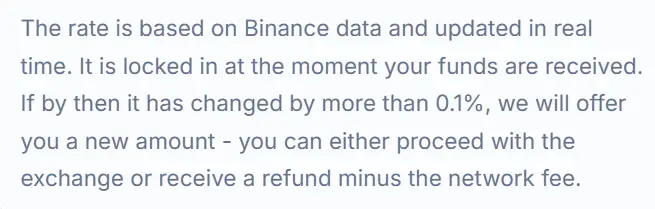
But the Terms of Service (clause 5.4) states:
If the Rate deviates by more than **0.3%** from the market rate... the Service may recalculate the Rate, resulting in either an increased or decreased payout
So the interface promises one thing (a recalculation at >0.1% deviation with a new rate offered), while what's legally on record is something else (the right to recalculate at >0.3% deviation in either direction, including reducing your payout). De facto, the service reserves the right to unilaterally change the rate after you've already sent your money.
Clause 6.2 of the Terms of Service — a penalty of up to 20% for a corporate card
withhold actual expenses and a fee of up to 20% of the received amount to cover potential losses, fees, and exchange-rate risks
If you accidentally pay with a corporate card (or the service decides your payment counts as a "prohibited payment instrument"), the penalty is up to 20% of the amount. That's a very aggressive sanction, and it looks more like a pressure tool than protection against violations.
Clause 6.5 of the Terms — 12 hours to withdraw cash via QR
A refund will be issued subject to a 5% fee and actual expenses (bank fees, exchange-rate losses, etc.)
If you don't manage to withdraw cash from an ATM via QR code within 12 hours (say, the ATM was down or you couldn't make it in time) — the transaction gets voided as "at the user's initiative" and they'll take 5% + bank fees + exchange-rate losses. 12 hours is a brutal deadline, especially given that ATMs can have technical failures.
AML Policy, clause 5 — a 180-day freeze
Assets may be blocked for up to 180 calendar days strictly for the purpose of conducting compliance checks and fulfilling mandatory legal, regulatory, payment partner, or law enforcement requirements.
Six months is the maximum asset freeze period. Meanwhile, clause 6.3 says that after the 180 days are up, the user has to contact support within 30 calendar days, otherwise... it's unclear what happens to the assets (formally, "the refund will not be made until the User fully complies with all requirements"). If the user misses that 30-day window, their funds may end up "stuck" with no refund.
AML Policy, clause 7 — a refund fee of up to 10%
A return processing fee of up to 10% of the transaction amount applies, in addition to any applicable network or payment system fees.
Even if you passed verification and your funds are being returned — they'll still take up to 10% (plus network fees). This contradicts the Refund Policy (clause 7), which says "such withholding may amount to up to 5% of the refund amount, but no more than the equivalent of 100 USD". Which of the two policies actually applies in practice is an open question.
AML Policy, clause 4.2 — no refunds for critical risk categories
Assets linked to critical risk categories are not eligible for return.
If a transaction gets classified as linked to "Mixing", "Sanctions", "Scam" etc. — the funds are not returned at all. A user who once received crypto from an exchange that later got sanctioned could lose everything.
AML Policy, clause 6.1 — invasive KYC requirements
To unlock funds you need: a selfie with the document, a video showing your full name, the document number, the service's name, the recording date, and the transaction reference, plus a demonstration of the source of funds (with the mobile app open). And a handwritten statement on top of that. It's a maximally invasive procedure that can work as a barrier — the harder verification is, the fewer people see it through to the end.
AML Policy, clause 4.1 — a contradiction in AML thresholds
The AML policy states that the maximum acceptable aggregate risk is 60%, and transactions with 50–60% risk are subject to mandatory additional review. But the "preliminary AML check" page says: "Transactions with an overall Risk Score above 50% are considered high risk: the order may be suspended". Different thresholds on different pages — 50% or 60%? That creates legal uncertainty.
Clauses 4.10 and 8.2 of the Terms — no guarantees
4.10 The Service uses reasonable efforts to process Applications as quickly as possible; however, it does not guarantee specific execution times...
8.2 The Service shall not be liable for the User’s losses arising from disruptions, errors, restrictions, or failures in the operation of software and/or hardware used to provide the Service...
The service doesn't guarantee timeframes and caps its liability at the transaction amount. Anything beyond that (lost profits, indirect losses) — not their problem.
No legal entity or jurisdiction
Nowhere in the Terms, the AML policy, or the Privacy Policy is there:
- a registered company name
- a legal address
- a jurisdiction of registration
- licenses
"Personal data controller is the MonetaGO.exchange service" — that's not a legal entity, just a brand. Rates.Guru lists the country as "Thailand", but with nothing to back it up. For a service with claimed reserves of $96 million (per Rates.Guru), the total absence of corporate transparency looks like a serious red flag.
Checking reviews on third-party sites and monitoring services
Rates.Guru
- Reputation: 84% (Green Zone)
- Reviews: 48/0/0 — 48 positive, 0 neutral, 0 negative
- Age: 9 months
- Reserves: $96,879,247
- Status: Active
- Order processing: "Instantly" (94% according to users)
- Support: "Works Well" (635 votes)
The reviews are mostly short and cookie-cutter: "Everything is fine", "Very good", "Fast exchanger". Some phrasing looks suspiciously templated, and the names are often Western (Thomas, Dorothy, Kenny, Liam, Emily) even though the service targets a Russian-speaking audience. That may be a sign of fake review inflation, though there's no direct proof.
WOT (Web of Trust)
- Security Score: 5% — an extremely low score
- 14 reviews, all positive
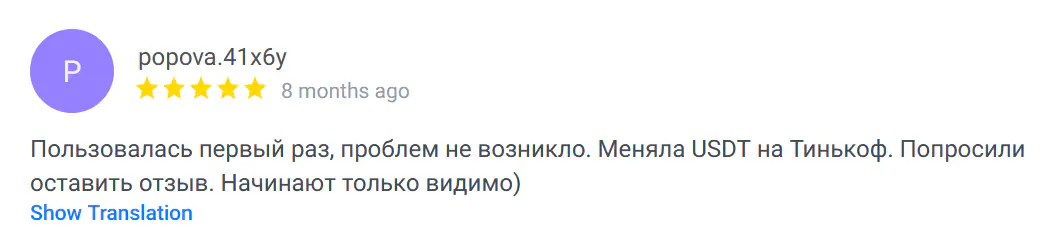
An interesting anomaly: a WOT score of 5% (the bare minimum) despite 14 positive user reviews. The WOT algorithm deemed the site unsafe even though users praise it. The WOT reviews also look templated: "Fast and convenient, no unnecessary filling in of personal data", "After many exchanges, they haven't let me down even once", "This is a completely special platform; I worked on it for a long time". One user even wrote: "Used it for the first time, no problems... They asked me to leave a review. Apparently that's when they start))".
Bitcointalk
There's an announcement thread for MonetaGO on Bitcointalk (topic 5577282) where the service promotes itself with promises of "low fees" and "data protection". But activity in the thread is minimal, and the content is a standard announcement.
The picture looks like this: the service has formally "good" reviews on the specialized monitoring sites (Rates.Guru), but:
- all the reviews are positive (0 negative in 9 months — statistically unlikely)
- the reviews look templated and one-liner
- a WOT score of 5% despite positive reviews — an anomaly
- no independent negative reviews, but also no "live" in-depth discussions on forums
- the domain is only 9 months old with claimed reserves of $96M
MonetaGO.exchange doesn't look like an outright scam (it's on monitoring sites, its terms are formally described, support responds), but the combination of red flags — contradictions in the documents, no legal entity, harsh sanctions, suspiciously "perfect" reviews, the young age — suggests the risk of losing your money in a non-standard situation (an AML flag, a cancellation after payment, a technical issue) is significantly higher than with more mature and transparent competitors. If you decide to use it — only with caution.
url
| domain | explore | registered | registrar | abuse email | score | average | |
|---|---|---|---|---|---|---|---|
| monetago.exchange | Dec. 10, 2025 | Porkbun LLC | [email protected] | 46/100 | 46.0 | ||
| Blacklist: NoCoin Hexxium QuidsUp URLhaus FadeMind MetaMask Phishunt Badd-Boyz BlackBook CoinMiner OpenPhish ThreatFox TweetFeed PhishRadar Scam Block Abuse Block Phishing DB ScamSniffer PhishDestroy Malware Block Phishing Army Toxic Domains Filters Heroes GlobalAntiScam Phishing Block Pi-hole Trojan Scam Blocklist Fraud Blocklist Pi-hole Malware Crypto Blocklist Pi-hole Phishing Ransomware Block CyberHost Malware Pi-hole Malicious Pi-hole C2 Servers Thread Intelligence PhishDestroy Community | |||||||
source
https://web.archive.org/web/20261002100028/https://monetago.exchange/en/pages/terms
https://web.archive.org/web/20261002100730/https://monetago.exchange/en/pages/aml
https://web.archive.org/web/20261002103409/https://monetago.exchange/en/pages/refund-policy
https://web.archive.org/web/20261002104420/https://monetago.exchange/en/pages/preliminary-aml-check
Trust Rating
related to the category