
Filter Trustpilot's BTCC page down to one-star reviews and it reads like a casebook of the same scheme over and over: deposits go through instantly, but at withdrawal time you're met with account blocks, endless verification and support that just goes silent. The reviews run from March through late September, and the patterns repeat so precisely they add up to a system.
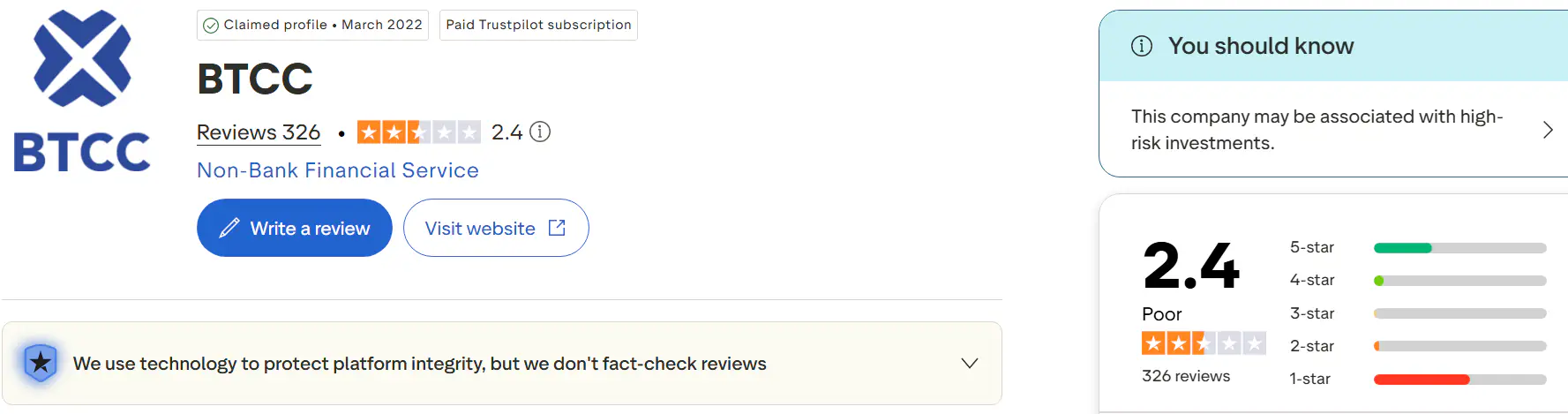
The most common complaint is a frozen withdrawal with a vague excuse about "anomalies". According to user Matt, his money sat on the exchange for over a year, but on his very first withdrawal attempt he got an email saying the system had detected anomalies, followed by forced KYC and an eternal "under review". BTCC's official response on March 25 boiled down to: Risk Control can proactively request verification for security reasons. Muhammed şamil berk reports $35,000 frozen and a chatbot that's been copy-pasting the same thing for a month. Mei from Poland says her 17,000 USDT balance was zeroed out under the pretext of a "temporary investigation" she's been waiting months for a reply, and she's now gathering victims for a class action — she left her account UID: fjpn4l.
The most detailed breakdown of this mechanism came from Scooby Dive in Germany. His small USDT withdrawal has been stuck for over two weeks, even though the amount is below the exchange's own published no-KYC limit. The support agent, he says, kept repeating the word "anomalies" but couldn't explain what exactly was anomalous, admitted support has no access to the reasons for the block, and claimed the supervisors are bound by confidentiality agreements. When he asked for the name of the FINTRAC compliance officer, they twice sent back a copy-pasted license number. A concrete timeline only appeared after he agreed to a selfie with his document — which he called not a security measure but a lever of pressure. He's preparing complaints to FINTRAC and FinCEN and sums it up like this: getting into an exchange is easy — it's when you try to get your money out that you find out what the platform really is.
The second category: outright balance deductions. Arash Tavangar from Canada deposited around $30,000, never traded at all, then after his account got restricted he found his balance had been "adjusted" down to roughly zero, and he's now publicly demanding an explanation of what contractual grounds they're holding his funds on. User j. IM from Korea reports two cases where, after withdrawal attempts in December 2023 and January 2024, the transactions were cancelled and a balance adjustment was applied to his account. The disputed amount is 68,639.94 USDT; out of eight support requests, he got five responses.
Then there's a whole separate layer: demands for extra payments. According to user Darrin, after ID verification and paying "taxes", they demanded another $6,000 to unlock his funds; the exchange has squeezed over $4,400 out of him total, and he's already filed reports with FBI IC3 and the FTC. Similar tricks with documents: Tony Farmer put in $400, handed over his license and a selfie, and then they asked for photos of his bank card from both sides plus a statement — in his view, a straight road to identity theft, especially since Coinbase never asked for anything like that. Lloyd William Godsey Jr lost $250 to the same script. Mubarak describes an absurd sequence: his first withdrawal, after a full document package, was approved — and the very next day, a second withdrawal to the exact same wallet was rejected on the grounds that the card was supposedly "different".
There are also reports of unauthorized access. farid says that on February 13, 2026, while he was asleep, six withdrawals totaling about 12,779.40 USDT left his account — with 2FA enabled, his phone switched off, and an active address whitelist which, by the way, is exactly where the money went. He's filed complaints with IC3 and FinCEN, and he questions whether BTCC even has the right to offer derivatives to Americans, since an MSB registration with FinCEN is not the same as CFTC or NFA authorization. Andrea from Italy lost about $67,000 without making a single withdrawal: an attacker churned trades through the illiquid VTCN/USDT pair with an extreme spread — over 100 transactions — and the platform later delisted the pair itself. According to him, 2FA isn't mandatory for login — only for withdrawals.
Special mention goes to the breakdown by Joel Kay from Switzerland. He claims trades on BTCC never get matched with other traders: the counterparty is a subsidiary dressed up as a "liquidity provider," the system knows your stop-loss, take-profit and liquidation price, and the price you're shown is just for show. As evidence, he points to his demo account, which he ran up from $2,500 to over $30,000 — even though on his real account, trading the exact same way, he kept steadily losing. Since switching to Hyperliquid, he calls the difference astronomical.
The legal contradiction described by user Joe is telling, too. BTCC's user agreement says services aren't offered to residents of the US, Ontario and Quebec, yet the platform was advertised to him in the US via Google Play, and his KYC with an American address went through without a hitch. He's already shown his materials to a lawyer.
Against this backdrop, BTCC's replies are cookie-cutter: apologies, a nudge to contact official support, and warnings about copycat sites. User dpn caught the irony: the exchange told him to contact official support through their website, he did exactly that — and now counts it as further proof of the problem.
But there's one bright spot: YT from Japan got his withdrawals through twice — purely by making noise in public. With a balance of around $130,000, his test withdrawal of 120 USDT sat pending for over 100 hours — case number 565089. After he posted his review, both withdrawals went through within hours, prompting his sarcastic remark: the real withdrawal document isn't a selfie or an ID — it's a public post.
One important warning to wrap up. Recovery scammers are lurking right in these reviews. User Micheal Krause tells a touching story about losing $78,500 and a mysterious helper who got back every last penny — but the first letters of his lines spell out POM ADVISORY, a classic acrostic ad for fund-recovery scammers. Patrick Fiedler is pushing Leintel dotcom, and Theodore Burger — some "M0NETIAN" where withdrawals are supposedly always fast. Exactly the scheme crypto-scam communities keep warning about: after a public complaint, the "saviors" start messaging the victim.
Bottom line: complaints are going to FBI IC3, the FTC, FINTRAC and FinCEN and Markus from Austria suggests writing to the Chinese embassy, of all things. In the Adanzye Kripto group of 8,000 members, people have had $35–40K each locked up for around 150 days, and the only answer to any question is the same line about risk control being triggered.
url
| domain | explore | registered | registrar | abuse email | score | average | |
|---|---|---|---|---|---|---|---|
| btcc.com | June 2, 1995 | Name.com, Inc. | [email protected] | 13/100 | 13.0 | ||
| Blacklist: NoCoin Hexxium QuidsUp URLhaus FadeMind MetaMask Phishunt Badd-Boyz BlackBook CoinMiner OpenPhish ThreatFox TweetFeed PhishRadar Scam Block Abuse Block Phishing DB ScamSniffer PhishDestroy Malware Block Phishing Army Toxic Domains Filters Heroes GlobalAntiScam Phishing Block Pi-hole Trojan Scam Blocklist Fraud Blocklist Pi-hole Malware Crypto Blocklist Pi-hole Phishing Ransomware Block CyberHost Malware Pi-hole Malicious Pi-hole C2 Servers Thread Intelligence PhishDestroy Community | |||||||
source
https://www.trustpilot.com/review/btcc.com
Trust Rating
related to the category